ALPHA-FIT TEST BATTERY NORMS FOR CHILDREN AND ADOLESCENTS FROM 5 TO 18 YEARS OF AGE OBTAINED BY A LINEAR INTERPOLATION OF EXISTING EUROPEAN PHYSICAL FITNESS REFERENCES
DOI:
https://doi.org/10.46827/ejpe.v0i0.2221Keywords:
alpha-fit, physical fitness, references, percentile scores, normsAbstract
Physical fitness has been shown to be a major health factor in both children and adolescents. One of the most widely applied physical fitness test batteries in Europe is the Alpha-fit. However, there is a reference gap between some of the ages. The aim of this study was to propose interpolated physical fitness percentile scores in children and adolescents for the main tests in the Alpha-fit test battery, which can be temporarily applied until this gap is filled in by experimental research. The recently available existing European normative values for children and adolescents were linearly interpolated in order to propose percentile scores to close the gap from 9.9 to 12.9 years of age in relation to the following tests: handgrip strength, standing long jump, and 4x10m shuttle run test (SRT). Similarly, other international references were combined with regard to the 20m SRT in order, thereby, to produce a full set of norms with the appropriate interpolations. The interpolated percentile scores obtained can be applied to assess the results from the Alpha-fit test battery of children and adolescents from 5 to 18 years of age. The combined percentile curves for handgrip strength, standing long jump, 4x10m SRT, and 20m SRT showed linearity, which sharpens between the ages of 9 and 13, and is probably connected with puberty. The proposed combined and interpolated reference values can be applied in order to evaluate European children and adolescents of all ages until the missing values are established by experimental research.
Article visualizations:

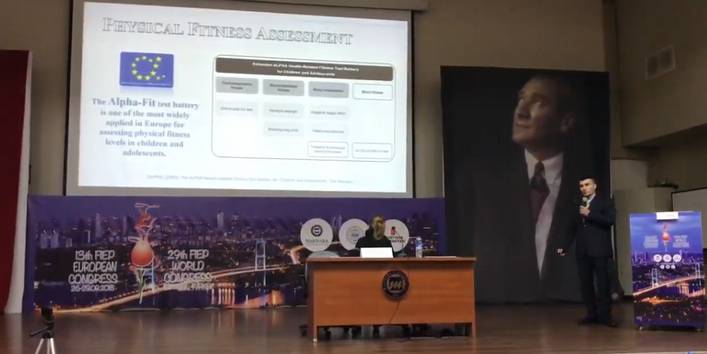
Note: Please click on the image for acceessing the video presentation at the 13th European & 29th World FIEP Congress in Istanbul, Turkey or access the link STK SPORT: https://www.stk-sport.co.uk.
References
ALPHA. (2009). The ALPHA Health-related Fitness Test battery for Children and Adolescents, Test Manual.
Castro-Pinero. J., E. Artero, V. Espana-Romero, F. Ortega, M. Sjostrom, J. Suni, & Ruiz, J. (2009). Criterion-related validity of field-based fitness tests in youth: A systematic review. . Br J Sports Med, 44, 934-943.
Cvejic, D., T. Pejovic, & Ostojic, S. (2013). Assessment of physical fitness in children and adolescents. Physical Education and Sport, 11(2), 135-145.
Ganley, K. J., Paterno, M. V., Miles, C., Stout, J., Brawner, L., Girolami, G., & Warren, M. (2011). Health-related fitness in children and adolescents. Pediatr Phys Ther, 23(3), 208-220. doi: 10.1097/PEP.0b013e318227b3fc
Kolimechkov, S. (2017). Physical Fitness Assessment in Children and Adolescents: A Systematic Review. European Journal of Physical Education and Sport Science, 3(4), 65-78.
Miguel-Etayo, P., L. Gracia-Marco, F. Ortega, T. Intemann, R. Foraita, L. Lissner, . . . Moreno., L. (2014). Physical fitness reference standards in European children: the IDEFICS study. International journal of Obesity, 38, 57-66.
Ortega, F., E. Artero, J. Ruiz, V. España-Romero, D. Jiménez-Pavón, G. Vicente- Rodriguez, . . . Castillo, M. (2011). Physical fitness levels among European adolescents: the HELENA study. British Journal of Sports Medicine, 45, 20-29.
Ortega, F. B., Ruiz, J. R., Castillo, M. J., & Sjostrom, M. (2008). Physical fitness in childhood and adolescence: a powerful marker of health. Int J Obes (Lond), 32(1), 1-11. doi: 10.1038/sj.ijo.0803774
Ruiz, J., J. Castro-Pinero, V. Espana-Romero, E. Artero, F. Ortega, M. Cuenca, . . . Castillo, M. (2010). Field-based fitness assessment in young people: the ALPHA health-related fitness test battery for children and adolescents. Br J Sports Med.
Santos, R., & Mota, J. (2011). The ALPHA health-related physical fitness test battery for children and adolescents. Nutr. Hosp., 26(6), 1199-1200.
Tomkinson, G. R., Lang, J. J., Tremblay, M. S., Dale, M., LeBlanc, A. G., Belanger, K., . . . Leger, L. (2016). International normative 20 m shuttle run values from 1 142 026 children and youth representing 50 countries. Br J Sports Med. doi: 10.1136/bjsports-2016-095987
Downloads
Published
Issue
Section
License
Authors who publish with this journal agree to the following terms:
- Authors retain copyright and grant the journal right of first publication with the work simultaneously licensed under a Creative Commons Attribution License that allows others to share the work with an acknowledgement of the work's authorship and initial publication in this journal.
- Authors are able to enter into separate, additional contractual arrangements for the non-exclusive distribution of the journal's published version of the work (e.g., post it to an institutional repository or publish it in a book), with an acknowledgement of its initial publication in this journal.
- Authors are permitted and encouraged to post their work online (e.g., in institutional repositories or on their website) prior to and during the submission process, as it can lead to productive exchanges, as well as earlier and greater citation of published work (See The Effect of Open Access).




